
Mesa · Dental Care
Dental Implants vs Dentures: A Mesa Retiree’s Honest Comparison
Dental Implants vs Dentures for Mesa Retirees For Mesa patients facing a missing tooth or multiple missing teeth, the choice between dental implants and dentures is one of the more consequential decisions in dentistry.…
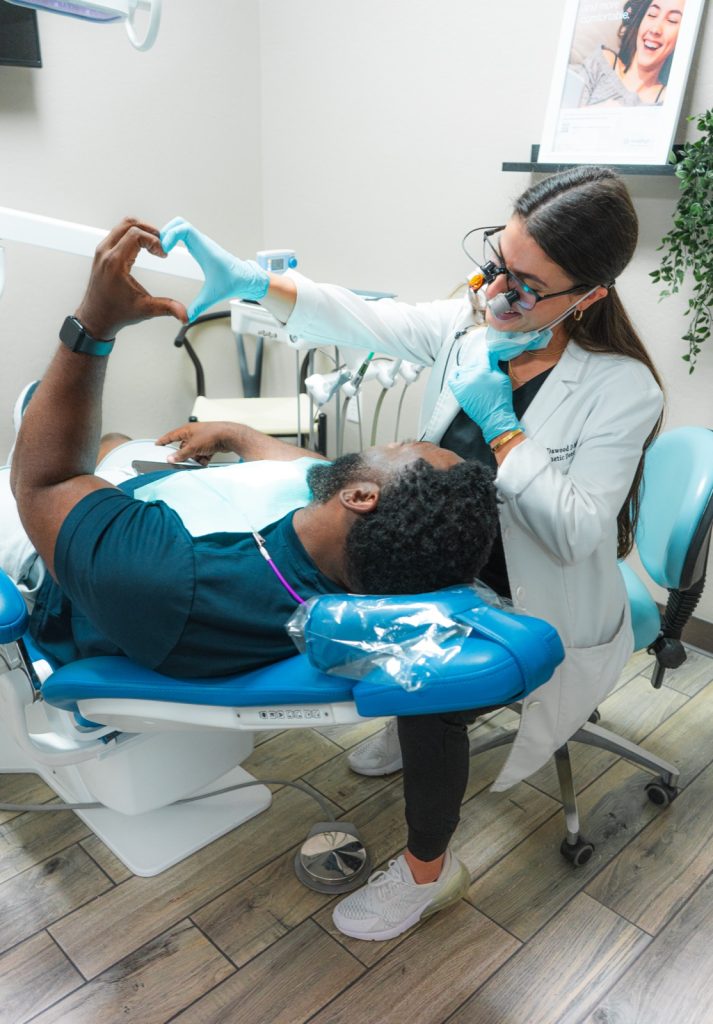
Dental Implants vs Dentures for Mesa Retirees
For Mesa patients facing a missing tooth or multiple missing teeth, the choice between dental implants and dentures is one of the more consequential decisions in dentistry. Both are mature, well-understood treatments. Both have specific situations where they are the right answer. Here is an honest comparison from a Mesa dentist who does both, aimed at adults weighing the decision.
Start with the functional question
Before anything else: what do you need the replacement teeth to do? Three use cases drive most of the decision:
- Chew normally. Eat what you want to eat without compromise. Steaks, apples, corn on the cob, hard bread. This is where implants substantially outperform dentures.
- Look natural. Modern dentures and implants both look good. Implants typically look better, especially up close, but well-made premium dentures are acceptable to most observers.
- Preserve bone. After tooth loss, the underlying jawbone begins to resorb. Implants stimulate bone and prevent resorption in the area they occupy. Dentures sit on top of gum tissue and do not stimulate bone; resorption continues beneath them, requiring reline or replacement every few years.
The functional priorities influence the recommendation more than cost or procedure length.
Implants, what they offer
See our complete dental implants guide for the full clinical picture. Key points for a Mesa patient weighing the decision:
Single missing tooth: one implant, one crown. It functions and feels like a natural tooth, and neighboring teeth are not cut down for a bridge. At Glisten Dental Mesa, a complete single implant starts from $2,900, including the fixture, abutment, and crown.
Multiple missing teeth: implant-supported bridgework or individual implants may be used depending on the number of teeth, the bite, bone volume, and budget.
Full arch: All-on-4 or a related full-arch approach uses implants to support a fixed arch of teeth. It does not come out like a traditional denture. See our All-on-4 page. At Glisten, All-on-4 is $15,999-$23,999 per arch. Per arch means upper or lower, not both arches.
Timeline: a straightforward single implant often runs about four months from consult to final crown. Full-arch and grafting cases can take longer because healing and bone support determine the pace.
Dentures, what they offer
Dentures remain a valid treatment. For some Mesa retirees, they are the practical answer because they avoid surgery, cost less up front, and can replace many teeth at once.
Traditional full dentures: an entire arch of replacement teeth on an acrylic base that fits over the gums. Upper dentures often have more suction because they cover the palate. Lower dentures are commonly harder to stabilize because the tongue, floor of the mouth, and smaller support area work against them.
Partial dentures: for patients with some remaining teeth. A removable appliance replaces missing teeth and uses remaining natural teeth for support. A partial denture may run roughly $1,200-$2,800 as a market range, not Glisten’s price.
Implant-supported dentures: a middle option between traditional dentures and fixed arches. Implants help stabilize a denture that still comes out for cleaning. It is not the same as All-on-4, because All-on-4 is a fixed full-arch option.
Cost comparison, realistic Mesa framing
The numbers should be separated by treatment type. A single implant and a full arch are not the same thing. A denture is not priced or maintained like an implant restoration.
| Situation | Implant path | Denture or non-implant path |
|---|---|---|
| One missing tooth | Single implant from $2,900 at Glisten, complete | Bridge roughly $2,500-$4,000 as a market range, not Glisten’s price; partial roughly $1,200-$2,800 as a market range, not Glisten’s price |
| Several missing teeth | Implant bridge or selected individual implants, priced after scan and design | Partial denture may be the lower up-front route |
| Most or all teeth in one arch | All-on-4 at $15,999-$23,999 per arch at Glisten | Traditional denture or implant-supported denture may fit when budget or health points away from fixed treatment |
| Recent extraction site | Implant may be possible if bone and infection status allow | Socket graft roughly $250-$450/site as a market range, not Glisten’s price, may preserve options |
For a deeper explanation of cost, insurance, AHCCCS, and Cherry financing, read the Mesa implant cost guide.
Insurance and Medicare for Mesa retirees
Original Medicare does not cover routine dental care. Medicare Advantage plans may include dental benefits, but coverage varies by plan. Glisten Dental Mesa has a free in-house specialist who helps navigate Medicare Advantage dental options, and the office is in-network with most major dental PPOs.
AHCCCS, Arizona Medicaid, has a limited adult emergency dental benefit with an annual cap. It is focused on urgent dental needs. Implants are generally not covered by the AHCCCS adult cap. That can be frustrating when an extraction was covered and the next question is how to replace the tooth, but it is better to state the limit clearly than to overpromise.
At Glisten Dental Mesa, benefits are reviewed before treatment and the estimate is explained before anything is scheduled. Cherry financing is available through the financing page, with terms depending on the actual plan and financing decision.
Honest scenarios, when each makes sense
Traditional dentures are the right choice when:
- Financial constraints make implants infeasible.
- Medical conditions make implant surgery a poor fit.
- Severe bone loss makes implants impractical without extensive rebuilding.
- The patient understands denture limitations and is comfortable with them.
- A transitional denture is needed while the mouth heals or while a phased plan is built.
Implant-supported dentures are the right choice when:
- The patient wants more stability than a traditional denture.
- The budget allows implant support but not a fixed full arch.
- A removable appliance is acceptable or preferred for cleaning.
- The lower arch is the main problem and denture movement is making meals difficult.
Fixed implants or All-on-4 are the right choice when:
- The patient wants teeth that stay fixed in place.
- The scan shows adequate support or a reasonable path to create support.
- Gum health and medical history support implant healing.
- The budget can accommodate the higher up-front investment.
- The patient understands that implants still require cleaning and maintenance visits.
Common misconceptions
“Dentures are just for old people.” Wrong. Dentures are for people who have lost teeth, because of disease, trauma, genetics, medication complications, or years of dental problems. Age is not the reason by itself.
“I am too old for implants.” Usually wrong. Age alone rarely decides candidacy. Bone, gum health, medical history, medication use, smoking, and the patient’s goals matter more than the birthday.
“Implants hurt a lot.” Many patients expect the recovery to be worse than it is. The Mesa implant guide explains Dr. Dawood’s approach to numbing, healing, and the timeline in more detail.
“Dentures are maintenance-free.” False. Dentures need daily cleaning, adjustments, relines, and eventual replacement. Implants also need maintenance because the gum and bone around them can develop infection.
“If I wait, I can still get implants later with the same plan.” Not always. Bone continues to change after tooth loss. Waiting can mean more grafting or fewer implant options later.
The Mesa factor
Mesa has a large retiree population, and the three patterns we see most often are practical, not cosmetic. Some patients in their 60s and 70s have worn loose dentures for years and want better chewing. Some are facing a new full-arch decision because remaining teeth are failing. Some patients in their 50s and early 60s are planning ahead because they watched a parent struggle with dentures.
The East Valley also brings access questions. A patient near Apache Junction or Gold Canyon may be trying to schedule around transportation. A household in Dobson Ranch may be comparing Medicare Advantage dental allowances. A Spanish-first family may need the plan explained by Dr. Carlos Rogel in Mesa so the decision is truly understood.
That is why the consult should not push one option before the scan. It should identify the bone, gum health, medical constraints, budget, and daily function goal, then match the recommendation to those facts.
When the choice is really All-on-4 vs traditional implants
Sometimes the comparison is not implants versus dentures. It is a fixed full arch versus a more traditional implant plan. All-on-4 may use a smaller number of implants to support a full fixed arch. Traditional implant planning may use more implants, individual crowns, or bridges in sections.
If that is the choice in front of you, read All-on-4 vs traditional implants for Mesa patients. It separates per-arch pricing, bone requirements, same-day teeth possibilities, and when a denture may still be the more honest answer.
Scheduling a consultation in Mesa
Call for a comprehensive tooth-replacement consultation at Glisten Dental Mesa. The visit includes imaging, bone assessment, medical history review, budget discussion, and a plain comparison of the paths that fit your situation. If implants are right, you should know why. If dentures are more sensible, you should hear that too.
Call 602-932-2555 to book a consultation, or use the /contact/ page.